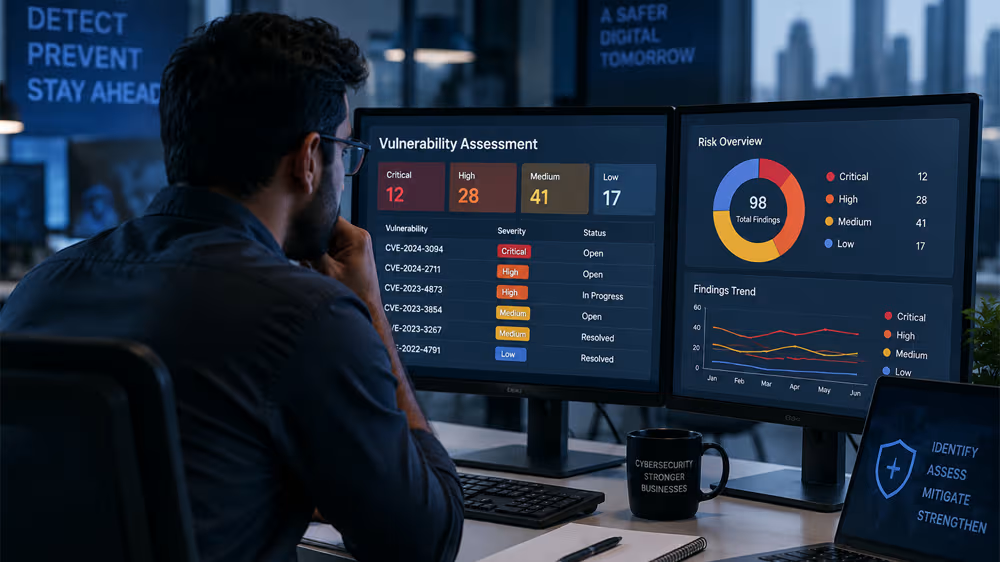
VAPT Services in Dubai: Why Vulnerability Scanning Alone Is Not Enough for UAE Businesses
A vulnerability scanner can tell you that something is wrong with your system. But it may not tell you whether an attacker can actually use that weakness to reach something important.
This is one of the reasons VAPT Services in Dubai are becoming more important for businesses that want to understand their real exposure.
Imagine receiving a security report showing 137 vulnerabilities.
Some are critical. Some are high. Others are medium or low.
Your IT team starts patching them one by one.
But there is a problem.
Which vulnerability could actually help an attacker get into the business? Which one could lead to sensitive data? Which weaknesses can be combined to create a larger attack?
A scanner cannot always answer those questions.
That is where vulnerability assessment and penetration testing work together.
According to NIST, vulnerability scanning is used to identify hosts, system attributes and associated vulnerabilities, while penetration testing goes further by attempting to determine whether vulnerabilities can actually be exploited.
For UAE businesses, the difference matters because security decisions should be based on real business risk, not simply the number of findings in a scanning report.
What Vulnerability Scanning Actually Tells You
Vulnerability scanning is useful.
It gives security teams a broad view of weaknesses across servers, network devices, applications, operating systems and other assets.
A scanner may identify:
Outdated software
Missing security patches
Open ports
Weak configurations
Unsupported software versions
Known vulnerabilities
Exposed services
Certificate problems
Misconfigured systems
For a business with hundreds of devices, manually checking every system would take an enormous amount of time.
Automated scanning makes this first layer of checking much faster.
This is an important part of Vulnerability Assessment Dubai services.
But a scan is primarily telling you:
“This weakness appears to exist.”
It is not necessarily telling you:
“An attacker can use this weakness to reach your customer database.”
That second question requires deeper testing.
NIST also notes that no single security testing technique provides a complete picture, and recommends combining appropriate testing techniques for a stronger assessment.
A Vulnerability Is Not the Same as an Exploitable Attack Path
This is one of the most important differences businesses should understand.
Suppose a server has a vulnerability rated as critical.
That sounds serious.
But imagine the server:
- Is not accessible from the internet
- Is isolated from important systems
- Has strong authentication
- Has limited user permissions
- Contains no sensitive information
The vulnerability still needs attention, but its practical business risk may be very different from a similar vulnerability affecting an internet-facing system connected to sensitive applications.
Now consider another situation.
A vulnerability rated as medium exists on an externally accessible application.
An attacker uses it to obtain a low-level account.
That account can access another internal system.
A second weakness allows privilege escalation.
The attacker then reaches a database containing customer information.
Individually, those findings may not look catastrophic.
Together, they create an attack path.
This is why VAPT Services in Dubai should not stop at producing a list of vulnerabilities.
The real question is:
What can an attacker do with them?
False Positives Can Distract Security Teams
Automated tools are useful, but they are not perfect.
A scanner may report a vulnerability that does not apply in the way the tool expects. It may identify a potentially vulnerable service without understanding the controls surrounding it.
These are commonly referred to as false positives.
False positives matter because security teams have limited time.
If an organization has 500 findings, the team cannot treat every item as equally urgent.
CISA guidance also highlights the need to validate false-positive claims and prioritize vulnerabilities according to the organization’s environment and risk.
A good Vulnerability Assessment Dubai process therefore involves more than running a scanner and exporting the results.
Findings need to be reviewed.
They need context.
And where appropriate, they need to be validated.
How Attackers Chain Multiple Weaknesses
Real attacks do not always depend on one spectacular vulnerability.
Sometimes an attacker wins by combining several ordinary weaknesses.
Consider a simple example.
Weakness 1: An external application has a security flaw.
Weakness 2: The compromised account has more permissions than necessary.
Weakness 3: An internal server trusts that account.
Weakness 4: A sensitive database is reachable from that server.
No single finding tells the complete story.
The attacker may use the first weakness to gain access, the second to increase permissions, the third to move internally and the fourth to reach sensitive information.
NIST specifically notes that penetration testing can involve looking for combinations of vulnerabilities across one or multiple systems that allow greater access than a single vulnerability would provide.
This is one of the biggest reasons scanning alone can leave businesses with a false sense of security.
Why Authentication and Privilege Matter
A vulnerability does not exist in isolation.
Authentication and permissions can completely change its impact.
Consider two employees.
One has access only to a basic internal application.
The other has administrator privileges across multiple systems.
If both accounts are affected by the same technical weakness, the possible consequences are not necessarily the same.
This is why a good Penetration Testing Dubai engagement should examine how access can be obtained, expanded and used within the agreed testing scope.
Testing may look at questions such as:
- Can an unauthenticated user access restricted functionality?
- Can a normal user reach administrative features?
- Can permissions be increased?
- Can one compromised account be used to reach another system?
- Can sensitive functions be accessed without the required authorization?
- Can security controls be bypassed?
The objective is not simply to find a technical flaw.
It is to understand what that flaw allows someone to do.
Penetration Testing vs Vulnerability Scanning
These two activities are related, but they are not the same.
Vulnerability Scanning
Vulnerability scanning uses automated tools to identify potential weaknesses.
It is useful for:
- Broad coverage
- Regular monitoring
- Finding known vulnerabilities
- Checking large numbers of systems
- Supporting patch management
Penetration Testing
Penetration testing goes further by attempting to validate whether security weaknesses can actually be used within the agreed scope.
It can involve:
- Manual testing
- Exploitation attempts
- Authentication testing
- Privilege escalation
- Access-control testing
- Application testing
- Attack-path analysis
- Chaining multiple weaknesses
NIST describes penetration testing as a method that attempts to circumvent or defeat security features and may involve combinations of vulnerabilities to achieve greater access.
So the simplest way to remember the difference is:
Vulnerability scanning asks: “What appears to be vulnerable?”
Penetration testing asks: “Can this weakness actually be used, and what could it lead to?”
A mature security program needs both.
External, Internal and Application Testing
Not every business has the same attack surface.
That is why VAPT Services in Dubai should be scoped around the systems that matter to the organization.
External Testing
External testing looks at systems that an attacker may be able to reach from outside the organization.
This can include:
- Public-facing servers
- VPN gateways
- Web applications
- Remote access services
- Internet-facing network devices
- Public APIs
The goal is to understand what an external attacker may be able to discover and exploit.
Internal Testing
Internal testing looks at what could happen after an attacker or malicious user has already gained some level of access.
It may examine:
- Internal servers
- User permissions
- Network segmentation
- Shared services
- Privileged accounts
- Lateral movement opportunities
This can expose weaknesses that an external scan cannot see.
Application Testing
Modern businesses depend heavily on web and mobile applications.
Application testing can examine issues involving:
- Authentication
- Authorization
- Session management
- Input handling
- Business logic
- API security
- Sensitive data exposure
For businesses operating customer portals, financial platforms, e-commerce systems or internal applications, application testing can be particularly important.
How VAPT Findings Should Be Prioritized
A report with 200 vulnerabilities may look alarming.
But the number itself does not tell management what should happen first.
Prioritization should consider more than a severity score.
A useful assessment should look at factors such as:
Is the system internet-facing?
Does it contain sensitive information?
Can the weakness be exploited?
Does exploitation require authentication?
What level of access could an attacker gain?
Can the attacker move to another system?
Are there controls that reduce the practical risk?
Is the affected system critical to business operations?
CISA recommends considering environmental factors, affected assets, exploitability, exposure and business importance rather than treating vulnerability scores as the only basis for prioritization.
This is where Vulnerability Assessment Dubai becomes more valuable when combined with human analysis.
The goal should not be:
“Fix the highest number first.”
It should be:
“Reduce the most important attack paths first.”
What Management Should Expect From a VAPT Report
A VAPT report should be useful to more than the cybersecurity team.
Management should be able to understand:
- What was tested
- Which systems were affected
- What the most serious weaknesses are
- Whether weaknesses could be exploited
- What an attacker could potentially achieve
- Which findings require immediate action
- Which findings can be scheduled
- What should be retested after remediation
A good report should also explain findings in business terms.
For example:
Instead of simply saying:
“Critical vulnerability found on Server X.”
The report should explain why it matters.
For example:
“The vulnerability may allow an attacker with initial access to execute unauthorized actions on the server. Because the server can communicate with the customer database environment, exploitation could increase the risk of unauthorized access to sensitive information.”
That gives decision-makers something they can act on.
Why Defense Numerique Takes VAPT Beyond the Scanner
At Defense Numerique, vulnerability scanning is treated as one part of a wider security assessment.
Our VAPT Services in Dubai combine vulnerability assessment with deeper validation to help businesses understand which weaknesses represent meaningful security risks.
The objective is not to give a company the longest possible vulnerability list.
It is to help answer practical questions:
Where can an attacker get in?
What can they access?
Can one weakness be combined with another?
How far could they move?
Which issue should the business fix first?
Our Penetration Testing Dubai services can help organizations test external systems, internal environments and applications within an agreed scope.
For businesses looking for a VAPT company in Dubai, the focus should be on understanding attack paths rather than simply counting vulnerabilities.
Final Thought
A clean vulnerability scan does not automatically mean a business is secure.
And a long vulnerability report does not automatically mean a business is in serious danger.
The important question sits between those two extremes:
Can an attacker turn the weaknesses that exist into a realistic path to something valuable?
That is what deeper security testing is designed to investigate.
For UAE businesses, VAPT Services in Dubai can provide a clearer picture by combining vulnerability discovery with penetration testing and human analysis.
At Defense Numerique, the goal is simple:
Find the weakness. Understand the attack path. Fix what matters most.
FAQ's
01.
No. Vulnerability scanning is useful for identifying potential weaknesses, but it does not always determine whether those weaknesses can be exploited or combined into a realistic attack path. Penetration testing adds deeper validation by testing how an attacker could use identified weaknesses.
02.
Vulnerability Assessment Dubai typically focuses on identifying and analyzing security weaknesses across systems and applications. Penetration testing goes further by attempting to validate whether selected weaknesses can actually be exploited. Using both provides a more complete view of technical security risk.
03.
The right frequency depends on the organization's size, technology, risk level and rate of change. Businesses should consider VAPT after major infrastructure or application changes and periodically as part of their security program. Internet-facing systems and critical applications may require more frequent testing.
04.
Yes. Penetration testing can uncover weaknesses that automated scanners may not identify because some problems depend on business logic, authentication, authorization, configuration relationships or combinations of vulnerabilities. Manual testing can also help validate whether a finding creates a practical security risk.
05.
A VAPT company in Dubai can provide human analysis alongside automated scanning. Experienced testers can examine attack paths, validate findings, assess authentication and privilege controls, and explain what vulnerabilities could mean for the business. This can help organizations focus remediation efforts on meaningful risks.
06.
Penetration Testing Dubai can include external, internal and application security testing depending on the agreed scope. Testing may examine exposed services, authentication, authorization, privilege escalation, application functionality, APIs, network segmentation and potential attack paths. The exact activities depend on the organization's systems and testing requirements.
07.
A company should first validate and prioritize the findings instead of attempting to fix everything in random order. Critical exploitable weaknesses affecting important assets should generally receive urgent attention. After remediation, important findings should be retested to confirm that the security issue has actually been addressed.
08.
No. A vulnerability score is useful, but business risk also depends on factors such as asset exposure, exploitability, system importance, available security controls, required access and the potential impact of compromise. This is why vulnerability prioritization should consider the organization's actual environment rather than relying on a score alone.
Tags :
Blog
Follow Us :
Related Post